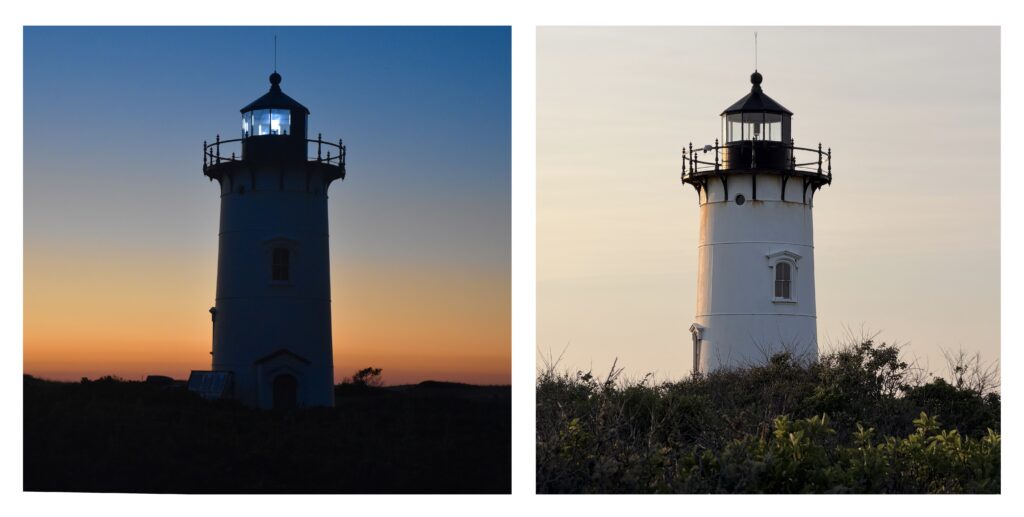
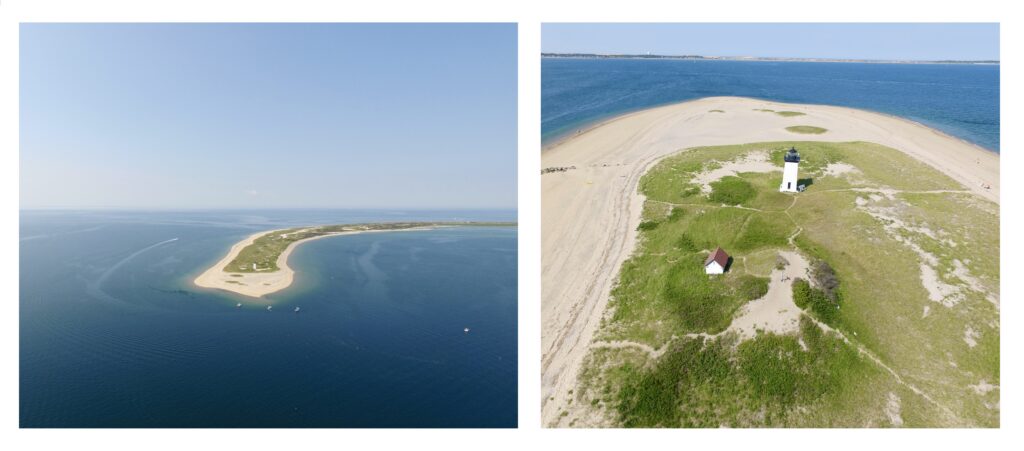
I was recently invited to share my thoughts on a passage from The Washashore. It gave me a chance to reflect, so I thought I’d capture some of those reflections here. The passage is a favorite of mine, taken from Chapter 45, in which Wren and Silas go on their first restaurant meal together—their first date. Here’s the excerpt, followed by my reflections.
EXCERPT – THE WASHASHORE, CHAPTER 45
Wren changed the subject to get herself out of the spotlight. “I’ve seen you looking at that lighthouse. Do you know the deal with that green light?”
“Can’t say I do,” he said, feeling relaxed, comfortable. He was eager to learn about the town through her eyes.
“So, this one’s Long Point Light, with the green flash.” She pointed over his shoulder. “Wood End Light, just around the bend there in the West End of town, blinks red.” He looked, nodding. He was familiar. “And the final light out here in Provincetown, Race Point Light, blinks white.”
“Now you mention it, seen that one too.”
“So, what’s neat is mariners and fishermen have always known about each light’s color from their charts, tradition, whatever. They know which color is associated with which location. At night or in bad weather, they can use the relative position of the colors to figure out exactly where they are and which way they need to steer to reach the shelter of the harbor.”
Silas was tickled by that bit of knowledge. “Huh. If only everythin’ else in life were that clear.” After a beat, he added, “Don’t suppose you’ve got a favorite one?”
“Lighthouse? Huh, good question. Never actually thought about it. Race Point is way out there, all windswept and isolated. It takes a long hike or Jeep ride over sand to reach it, which makes it special. Plus, it’s the only cylindrical one of the three, which also makes it unique. Casts gorgeous shadows across the cylinder’s curve when the sun gets low. But white light is kinda boring, right?”
Silas jerked his head back in mock surprise. “Makin’ a strong case for that one, till you pulled the rug out at the last minute.”
Wren’s eyes twinkled as she smiled. “Wood End is easy enough to walk to along the breakwater. We’re going to need to do that with Bandit sometime soon, by the way.”
We sure are.
“I like Wood End Light. I’ve gotten some good sunrise shots of it, timed perfectly so the red blink of the light blended into the reddish colors of dawn. There was coppery-colored sun reflected in the wavy old glass windows too. Very fun.”
She’s starting to take this analysis more seriously than expected. Winner’s gonna be valid.
“But I think Long Point has to be considered my favorite. It’s a familiar friend, blinking away, right here in the middle of a busy harbor. And it marks the absolute tip of the whole entire cape—‘land’s end,’ as they say around here. Plus, it reminds me of a favorite book. The green light in the book became a symbol of dreams, yearning, and hope. Gives this light some heft.”
On the surface, this is a conversation about lighthouses. Underneath, it’s about two very different people finding a common language.
The passage is also a perfect example of how I like to approach writing. I tend to put character before spectacle—I tend to approach plot in service of people, not the other way around. My characters are not pawns in a plot; instead, the plot is a thing that happens as part of their lives. I look at place as a character and of itself—setting, atmosphere—they are more than a backdrop, they are the characters' context.
I love to include symbolism for observant and thoughtful readers, but it has to be earned and quiet, rather than bluntly imposed. This often intersects with setting and atmosphere. The above excerpt is a good example of this kind of symbolism: I think of a characters' navigation through physical space as a mirror for their moral navigation.
I love scenes like this because almost nothing “happens” in them, yet they quietly show the reader an enormous amount. Deepening the readers understanding of a character or progressing a relationship is plenty of heavy lifting for a scene.
An example of that in this scene is Silas’s respect for Wren’s knowledge and intelligence. Despite coming from a traditional ranching culture that prizes self-reliance, strong convictions, and figuring things out for yourself, Silas isn’t threatened by Wren’s expertise. He’s far more interested in learning from her than talking at her.
More importantly, it beautifully weaves together several recurring motifs in the book: light in all its changing qualities, life shaped by the sea, photography as the art of gathering light, the wild, windswept beauty of Provincetown’s otherworldly dunescape, and Wren and Silas’s shared love of literature, and navigation through a kind of intuitive, principles-based dead reckoning.
It introduces the idea that navigation isn’t only geographical—throughout the novel, characters are trying to find their bearings morally as well as physically. The same instincts that help a mariner find safe harbor become a metaphor for living according to a dependable moral compass.
Plenty of mystery writers can talk about clues, twists, or pacing. Fewer can explain why a quiet conversation about lighthouse colors belongs in a murder mystery—and make readers want to read it. This excerpt is a good example of the kind of scene that has almost nothing to do with advancing the plot (sorry, thriller addicts!) and everything to do with world-building, character, relationships, and creating the emotional texture readers remember long after the mystery has been solved.
If you are interested in ordering The Washashore you can find it at—or order it from— these local bookstores.
Essential cookies enable basic functions and are necessary for the proper function of the website.
Name
Description
Duration
Cookie Preferences
This cookie is used to store the user's cookie consent preferences.
30 days
These cookies are needed for adding comments on this website.
Name
Description
Duration
comment_author
Used to track the user across multiple sessions.
Session
comment_author_email
Used to track the user across multiple sessions.
Session
comment_author_url
Used to track the user across multiple sessions.
Session
Statistics cookies collect information anonymously. This information helps us understand how visitors use our website.
GoDaddy's visitor traffic tracking, added automatically to sites hosted with GoDaddy and to sites built with GoDaddy Website Builder. It records page views, clicks, and page timing, and sends them to GoDaddy to measure traffic and site performance.
Stores a randomly generated visitor ID so GoDaddy's traffic tracking recognizes a returning visitor across sessions.
1 year
_tccl_visit
Stores a randomly generated ID for the current visit so page views and clicks can be grouped into one session.
30 minutes
_scc_session
Holds the number of pages viewed in the current visit and the time of the last interaction, so GoDaddy's traffic tracking can tell when a visit has ended.
20 minutes
Google reCAPTCHA helps protect websites from spam and abuse by verifying user interactions through challenges.
Name
Description
Duration
_GRECAPTCHA
Google reCAPTCHA sets a necessary cookie (_GRECAPTCHA) when executed for the purpose of providing its risk analysis.